
When you’re considering professional mental health support, you may wonder:
“Should I see a therapist or a psychiatrist?”
It’s a common question.
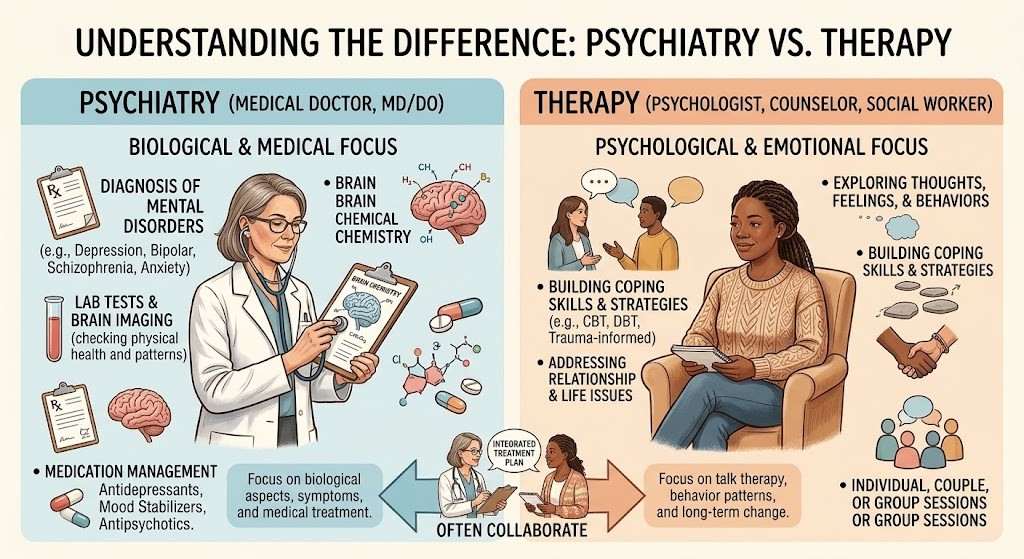
Although therapists and psychiatrists both support mental health, their training, roles, and approaches can differ.
Understanding the distinction can help you make a more informed decision about the type of care you may need.
What Is Therapy?
Therapy, often called psychotherapy, involves working with a trained mental health professional to explore thoughts, emotions, behaviors, relationships, and life experiences.
Therapy can provide a safe environment to discuss challenges and develop strategies for managing them.
People may seek therapy for concerns such as:
- Anxiety
- Depression
- Stress
- Grief
- Relationship difficulties
- Family challenges
- Trauma
- Life transitions
- Emotional difficulties
- Personal growth
Different therapists may use different evidence-based therapeutic approaches depending on their training and the client’s needs.
What Is Psychiatry?
Psychiatry is a medical specialty focused on the assessment, diagnosis, treatment, and prevention of mental, emotional, and behavioral disorders.
Psychiatrists are medical doctors who receive specialized training in mental health.
Because psychiatrists are physicians, they can evaluate whether medication may be appropriate as part of treatment.
Psychiatric care may involve:
- Psychiatric evaluations
- Assessment of mental health symptoms
- Diagnosis when appropriate
- Medication management
- Monitoring treatment response
- Follow-up care
- Coordination with other healthcare professionals
Therapist vs. Psychiatrist: Key Differences
| Therapist | Psychiatrist |
|---|---|
| Primarily provides psychotherapy | Provides medical psychiatric care |
| Focuses on thoughts, emotions, behaviors, and relationships | Evaluates mental health from a medical and psychiatric perspective |
| Helps develop coping and behavioral strategies | May prescribe and manage psychiatric medication |
| Can support grief, anxiety, relationships, stress, and life transitions | Can assess and treat psychiatric conditions |
| Often meets regularly for therapy sessions | May provide ongoing psychiatric follow-up |
These roles are different, but they can also complement one another.
Can You See Both a Therapist and Psychiatrist?
Yes.
In some situations, a person may receive both psychotherapy and psychiatric care.
For example, someone experiencing depression may work with a therapist to explore thoughts, behaviors, relationships, and coping strategies while also receiving psychiatric evaluation and medication management when clinically appropriate.
The combination of services should be individualized to the person’s circumstances.
Which One Should You See?
There isn’t one answer that applies to everyone.
If you’re primarily looking for a confidential space to explore emotions, relationships, behaviors, or life challenges, therapy may be an appropriate place to start.
If you are experiencing symptoms that may require psychiatric evaluation or you are interested in discussing medication as part of your treatment, a psychiatrist may be appropriate.
If you’re uncertain, you can start by contacting a qualified mental health provider and discussing your concerns.
What If You Don’t Know What You Need?
That’s completely understandable.
You don’t need to diagnose yourself before seeking help.
A qualified mental health professional can listen to your concerns, understand your situation, and help determine what type of support may be appropriate.
The most important thing is to take that first step.
Mental Health Care Should Be Personalized
At Serenity Integrative Services, we believe mental health care should be built around the individual.
Your experiences, challenges, goals, relationships, and circumstances matter.
Whether you need therapy, psychiatric support, wellness guidance, or another form of professional care, the goal is to help you access appropriate support.
Take the First Step
If you’re looking for therapy or psychiatric services in New York, Serenity Integrative Services is here to provide compassionate, personalized support.
Reach out today to learn more about our services or schedule an appointment.
Such a valuable post! The counselling techniques shared here are practical and really help in managing emotions more effectively. Definitely some strategies I can start applying for healthier emotional well-being.